
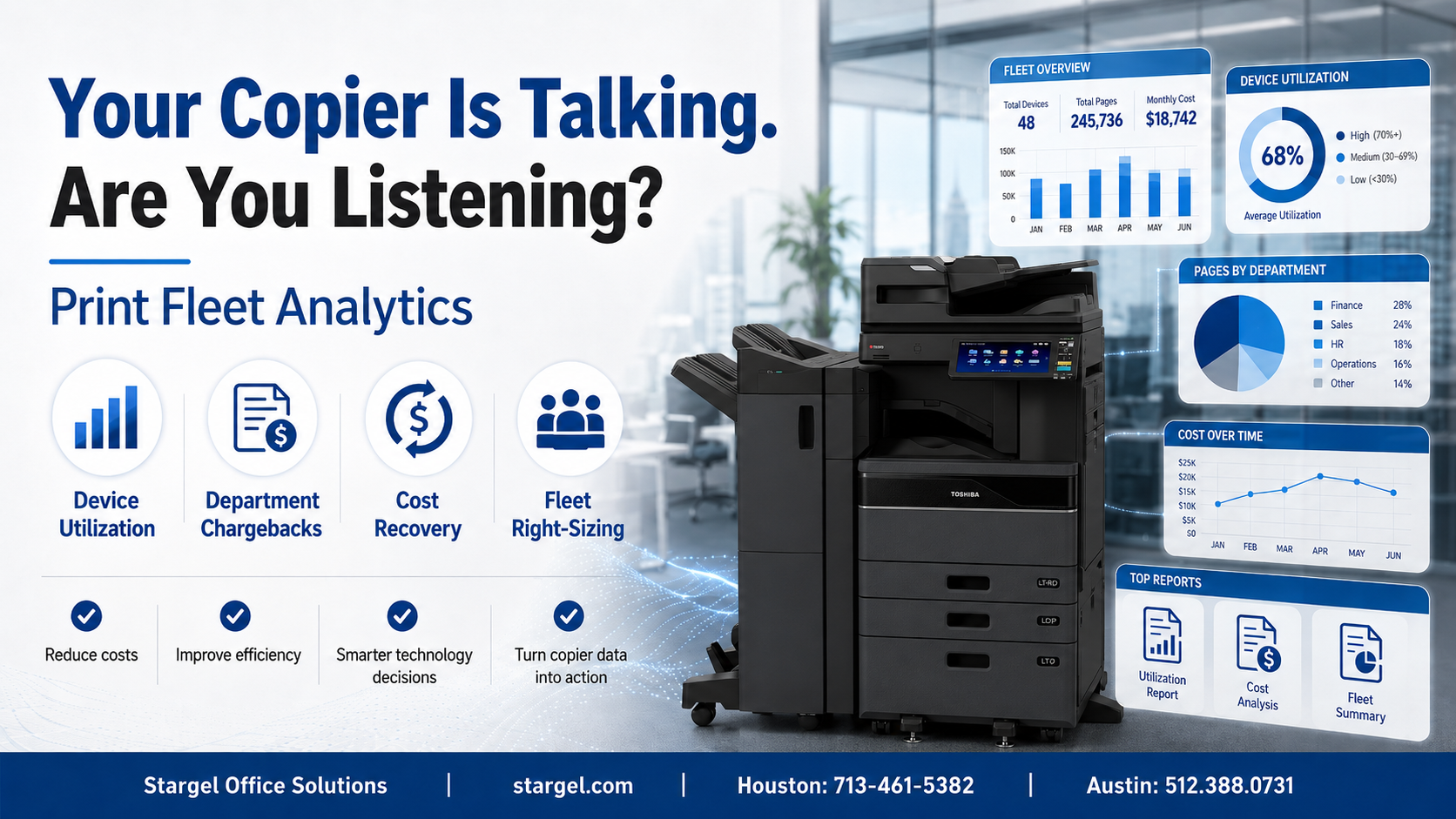
Print Fleet Analytics: Your Copier Is Talking. Are You Listening?
Print Fleet Analytics: Your Copier Is Talking. Are You Listening?
Estimated Read Time: 4 Minutes
Print fleet analytics can help your business turn everyday copier and printer data into better decisions.
For years, many businesses viewed copiers as a basic office expense. They printed, copied, scanned, and occasionally caused frustration when something broke.
However, that mindset is changing.
Today’s multifunction printers do more than produce documents. They also collect useful data about print volumes, scan activity, department usage, service history, color output, and device performance.
As a result, your copier may already be telling you where your business can reduce costs, improve efficiency, and make smarter technology decisions.
The question is simple:
Are you listening?
The Hidden Value in Your Print Fleet
Every day, your copiers, printers, and multifunction devices collect information that can help your business understand how employees use office technology.
This data may include:
- Print and scan volumes
- Department usage
- Color versus black-and-white output
- Device utilization
- Service history
- User behavior
- Workflow activity
When businesses review this information, they can move beyond simple service reports and invoices.
Instead, they can use copier analytics to make better decisions about cost, workflow, equipment placement, and future technology needs.
Device Utilization Reports Tell a Bigger Story
One of the most useful parts of print fleet analytics is the device utilization report.
Many organizations assume every printer or copier works at full capacity. However, the data often tells a different story.
For example, one device may run at less than 20% of its recommended monthly volume. Meanwhile, another department may overuse a device that was not designed for that workload.
When businesses review utilization reports on a regular basis, they can:
- Identify underused equipment
- Reduce unnecessary lease expenses
- Improve employee productivity
- Eliminate print bottlenecks
- Plan future technology investments more effectively
In other words, data helps remove guesswork.
Instead of assuming where problems exist, your business can use facts to guide better decisions.
Department Chargebacks Create Accountability
Many organizations struggle to understand where printing costs actually begin.
For example, one department may print large amounts of color output. Another may rely heavily on scanning. A third may use several small printers that cost more to operate.
Without reporting, these costs can remain hidden.
With department tracking and chargeback reporting, businesses can assign printing expenses to specific teams, departments, or cost centers.
This can help create:
- Better budget forecasting
- More accountability
- Less wasteful printing
- Smarter financial decisions
As a result, departments can better understand how their printing habits affect the overall business.
Often, when teams see their true printing costs, behavior begins to change naturally.
Print Cost Recovery Opportunities Are Often Missed
Many businesses spend more than they realize on unnecessary output, unmanaged color printing, and duplicate devices.
However, regular print reviews can uncover cost recovery opportunities that may otherwise go unnoticed.
These opportunities may include:
- Consolidating devices
- Redirecting print volumes
- Adjusting color printing policies
- Eliminating duplicate equipment
- Moving devices to better locations
- Replacing high-cost printers with more efficient options
What starts as a simple print review can often reveal meaningful savings.
More importantly, it can help your business build a print environment that better supports the way your employees work today.
Is Your Printer Fleet the Right Size?
Workplaces continue to change.
However, many businesses still have printer fleets designed for old staffing levels, outdated workflows, or office layouts that no longer fit current needs.
That is why printer fleet right-sizing matters.
Right-sizing helps align your printers, copiers, scanners, and multifunction devices with your actual business needs.
Important questions include:
- Do we have too many devices?
- Do we have enough scanning capacity?
- Are employees walking too far to access equipment?
- Are certain departments experiencing too much downtime?
- Are some devices underused while others are overloaded?
The goal is not simply fewer devices.
Instead, the goal is to place the right devices in the right locations.
Data-Driven Reviews Help Prevent Problems
The most valuable print review is often the one that happens before a problem occurs.
Instead of waiting for equipment failures, contract expirations, service complaints, or competitive bids, businesses can schedule regular operational reviews.
These reviews can focus on:
- Current print volumes
- Service trends
- Device performance
- Department usage
- Cost recovery opportunities
- Future print and scan needs
Because of this, your business can make adjustments before small problems become bigger issues.
These conversations also help create stronger partnerships between your team and your office technology provider.
Why Print Fleet Analytics Matters for Businesses in Houston, Austin, and Central Texas
Businesses in Houston, Austin, Round Rock, Brenham, Navasota, and Bryan/College Station need office technology that supports daily operations, growth, and cost control.
However, many organizations still manage print fleets based on habit instead of data.
Print fleet analytics gives local businesses a clearer view of what is happening across their print environment.
For example, Stargel Office Solutions can help businesses review device usage, service history, print volumes, fleet size, and cost recovery opportunities.
With better reporting, your business can make smarter decisions about copier placement, printer upgrades, managed print services, and long-term technology planning.
From Copier Vendor to Business Advisor
The future of office technology is not just about selling more hardware.
It is about helping businesses use information more effectively.
When a provider delivers utilization reports, financial transparency, optimization recommendations, and regular business reviews, that provider becomes more than a copier vendor.
They become a trusted business advisor.
That type of partnership can help businesses improve efficiency, strengthen planning, reduce waste, and stay ahead of future needs.
Turn Copier Data Into Better Business Decisions
Every copier in your organization is generating useful business information.
The question is not whether the data exists.
The real question is whether your business is using it to improve operations, reduce costs, and support better decisions.
The most successful organizations are not just managing print fleets anymore.
They are managing the data those fleets provide.
Stargel Office Solutions can help your business turn print fleet analytics into a smarter, more efficient print strategy.