
AI Governance: The Hidden Costs of Unmanaged AI Tools
AI Governance: The Hidden Costs of Unmanaged AI Tools
Estimated Read Time: 4 Minutes
AI governance is becoming an important business topic as employees use artificial intelligence tools more often at work.
Today, employees use tools like ChatGPT, Microsoft Copilot, Claude, Gemini, and AI browser extensions to write emails, summarize meetings, create reports, review spreadsheets, and even help with software code.
In many cases, these tools can save time. However, many businesses do not know when, where, or how employees are using them.
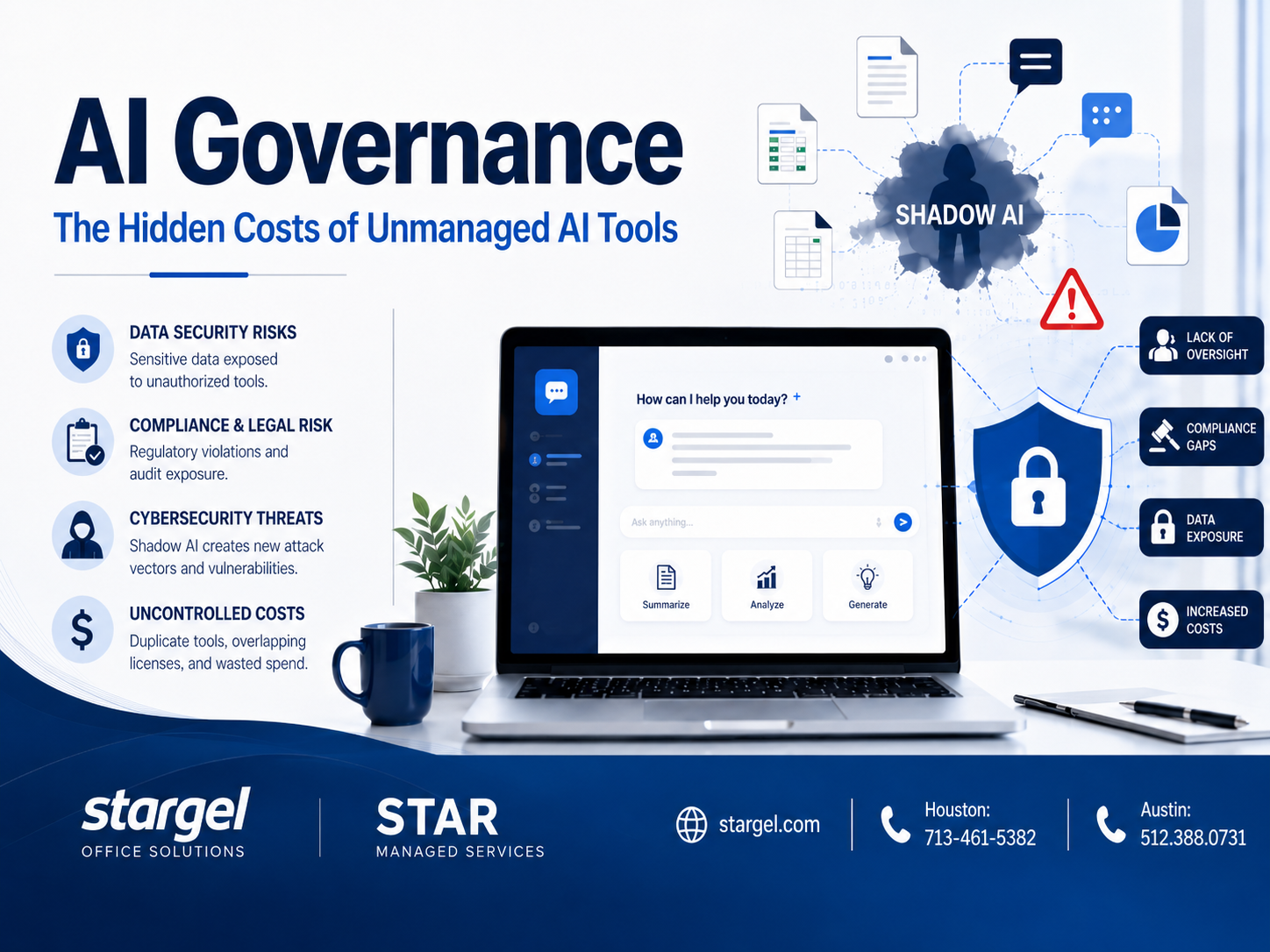
As a result, companies may already have a growing issue known as Shadow AI.
Shadow AI happens when employees use AI tools without approval, rules, or oversight from leadership or IT. Although these tools can help employees work faster, unmanaged AI tools can also create data risks, security concerns, extra costs, and uneven work quality.
Because of this, businesses should understand the hidden risks before AI becomes another unmanaged tool in the workplace.
What Is Shadow AI?
Shadow AI means employees are using artificial intelligence tools without company approval or IT oversight.
For example, an employee may paste a customer proposal into an AI chatbot to improve the wording. Another employee may upload a spreadsheet for quick review. Meanwhile, someone else may use AI to draft an HR policy or summarize meeting notes.
Most of the time, employees are not trying to create problems. Instead, they are trying to get work done faster.
However, without clear AI governance, your company may lose control over where sensitive information goes and how employees use it.
1. Unmanaged AI Tools Can Expose Sensitive Company Data
Most employees do not mean to create security problems. They simply want to save time.
However, when employees copy company information into public or unapproved AI tools, that data may move outside your control.
This can include:
- Customer proposals
- Financial spreadsheets
- Contracts
- HR documents
- Internal reports
- Client information
- Software code
As a result, every business should ask:
- What information are employees sharing with AI tools?
- Are employees uploading customer data?
- Are employees using AI with contracts or financial records?
- Could this violate client agreements or company rules?
Without visibility, your business simply does not know.
2. AI Compliance Risks Can Grow Quietly
Many organizations must follow strict rules about how they store, share, and protect information.
For example, this can affect companies in healthcare, legal, finance, manufacturing, education, and government contracting.
Even when employees have good intentions, AI use can still create compliance issues if they upload protected information into unapproved AI platforms.
Depending on your industry, unmanaged AI usage may affect:
- HIPAA compliance
- PCI-DSS requirements
- CMMC readiness
- Client confidentiality agreements
- Internal security policies
Compliance is not only about preventing data breaches. It is also about keeping control over where sensitive information goes.
3. Inconsistent AI Results Can Hurt Your Brand
AI can be helpful. However, it is not always correct.
When every employee uses a different AI tool with different prompts and different expectations, your company may see mixed results.
For example, this can lead to:
- Inconsistent customer communication
- Incorrect technical information
- Outdated recommendations
- Wrong calculations
- Documents that do not follow company standards
Over time, these issues can affect your brand, customer experience, and internal quality standards.
Therefore, AI governance should include clear rules, approved tools, and simple review steps for AI-assisted work.
4. Shadow AI Creates New Cybersecurity Risks
Cybercriminals often move quickly when new technology becomes popular.
Because AI tools are now widely used, fake AI websites, harmful browser extensions, and fraudulent AI apps have become a real concern.
For instance, employees searching for “free AI tools” may install software that steals passwords, captures data, or harms company devices.
In addition, AI-generated phishing emails can sound more polished and believable.
Because of this, employee training and awareness matter more than ever.
5. Businesses Lose Visibility Into Their Technology Environment
One of the biggest challenges for IT teams is managing technology they do not know exists.
Today, many organizations can track every company laptop. However, they may not know which AI tools employees use.
Without visibility, IT teams cannot easily:
- Review security risks
- Control data access
- Manage software licenses
- Create usage rules
- Support employees effectively
In short, you cannot protect what you cannot see.
6. Too Many AI Subscriptions Can Increase Costs
Many employees purchase AI subscriptions using company credit cards or expense accounts.
Over time, businesses may pay for several tools that perform similar tasks.
These may include:
- ChatGPT subscriptions
- Microsoft Copilot licenses
- Claude Pro accounts
- Gemini Advanced subscriptions
- AI meeting assistants
- AI writing platforms
- AI browser extensions
Often, these tools overlap.
Therefore, a clear AI plan can help your business choose standard tools, reduce extra spending, and make better license decisions.
What Businesses Should Do Instead
The answer is not to ban AI completely.
In fact, companies that completely prohibit AI may discover that employees continue using it anyway without telling anyone.
Instead, businesses should create AI governance with clear and practical rules.
Establish Approved AI Tools
First, decide which AI tools employees may use and why.
This helps reduce confusion and keeps employees from choosing random tools on their own.
Create a Clear AI Use Policy
Next, define what information employees can and cannot enter into AI systems.
For example, your policy should include rules for customer data, financial data, HR information, contracts, and private company information.
Train Employees on AI Risks and Best Practices
Then, train employees on both the benefits and risks of AI.
With the right training, they can use AI more safely and more effectively.
Work With Your IT Provider
Finally, your managed IT provider can help review AI tools, check security settings, support approved platforms, and align AI use with your cybersecurity plan.
For additional guidance, the National Institute of Standards and Technology offers an Artificial Intelligence Risk Management Framework to help organizations manage AI-related risks. Learn more about the NIST AI Risk Management Framework.
AI Is Here to Stay
Artificial intelligence is already changing how people work.
Businesses that use AI thoughtfully can gain major productivity benefits.
However, organizations that ignore AI governance may create security risks, compliance issues, software waste, and uneven work quality without realizing it.
The goal is not to slow innovation.
Instead, the goal is to help your business adopt AI safely, strategically, and with the right safeguards in place.
How Stargel and Star Managed Services Can Help
If you are unsure how employees use AI within your organization, now is the time to find out.
At Stargel Office Solutions and Star Managed Services, we help businesses create practical AI policies, review secure AI tools, strengthen cybersecurity, and give employees guidance for safer AI use.
AI can become one of your organization’s greatest advantages. However, your business needs to manage it with the same care as every other critical technology.
Reach out to your Stargel or Star Managed Services representative today to learn how we can help your company develop an AI Use Policy.