
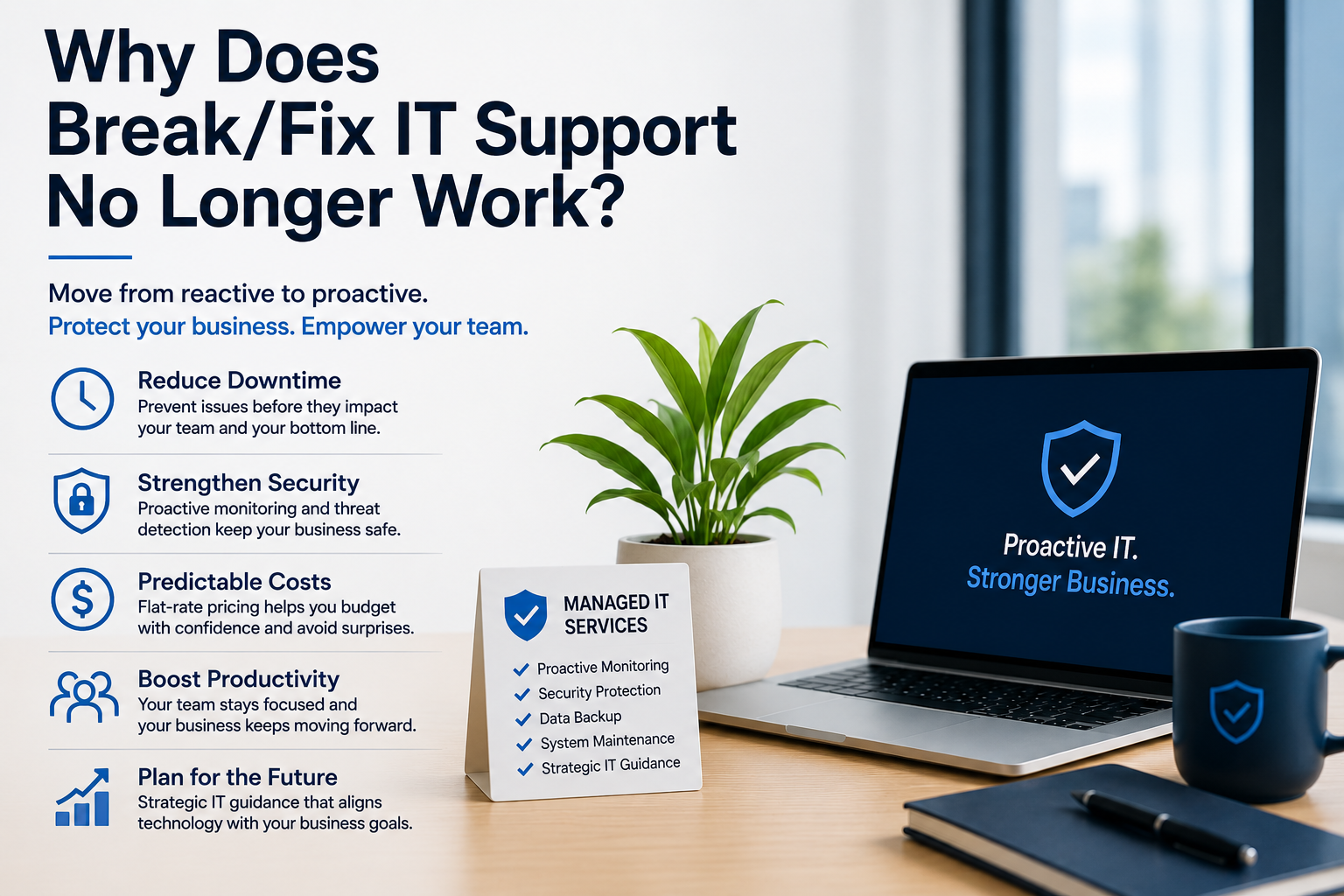
Why Break/Fix IT Support No Longer Works
Why Break/Fix IT Support No Longer Works
Estimated Read Time: 4 Minutes
For years, small and medium-sized businesses used the break/fix model as their standard approach to IT support.
Something breaks, you call an IT company, they fix the problem, and you pay for the service.
At first, that may sound simple and cost-effective. However, today’s technology environment has changed.
Cybersecurity threats, cloud applications, remote work, compliance requirements, and daily business dependence on technology now expose the weaknesses of the break/fix approach.
Here is the reality: waiting until something goes wrong no longer gives businesses a smart IT strategy.
The Problem with Reactive IT Support
The break/fix model follows a reactive mindset. In other words, businesses address IT issues only after those issues impact operations.
That creates several problems:
- Employees lose productivity while systems stay down
- Outages can cause missed revenue opportunities
- Cybercriminals can compromise critical data
- Emergency repairs often cost more than preventive maintenance
- Businesses gain little visibility into hidden technology risks
Think about your vehicle. Instead of getting regular oil changes, replacing worn tires, or checking the brakes, imagine waiting until the engine fails on the highway.
Most business owners would never manage transportation that way. Yet many still manage their IT infrastructure using that same approach.
Cybersecurity Has Changed the Rules
One of the biggest reasons break/fix IT support no longer works is cybersecurity.
Modern cybercriminals do not wait for systems to fail. Instead, they actively look for vulnerabilities, outdated software, weak passwords, and unmonitored devices.
By the time a business discovers a problem, the damage may already be done.
A reactive IT provider may help after an attack. However, recovery usually costs far more and disrupts the business much more than prevention.
Today’s businesses need more than occasional support. They need continuous monitoring, security updates, vulnerability management, employee training, and proactive threat detection.
Those services simply do not fit within the traditional break/fix model.
Downtime Is More Expensive Than Ever
Technology no longer serves only as a support function. It now forms the foundation of most business operations.
When systems go down, employees cannot work, customers cannot receive service, and communication can quickly slow down.
Even one hour of downtime can create a major impact through lost productivity, missed opportunities, and frustrated customers.
So, businesses should not only ask:
“How much does proactive IT support cost?”
Instead, they should ask:
“How much does downtime cost our organization?”
The Hidden Costs of Break/Fix IT Support
Many organizations choose break/fix support because it appears less expensive on paper.
However, the true costs often show up later. These may include:
- Emergency service rates
- Unplanned hardware replacements
- Lost employee productivity
- Business interruption
- Data recovery expenses
- Cybersecurity incidents
- Compliance issues
When businesses add these costs together, break/fix IT support can become far more expensive than a proactive managed IT services approach.
Modern Businesses Need Strategic IT Support
Technology decisions now affect every area of a business.
Business leaders need to ask important questions, such as:
- Have we protected our business against ransomware?
- Do we back up our data properly?
- Can our employees work securely from anywhere?
- When should we replace aging hardware?
- Have we prepared our technology for growth?
These questions involve more than technology. They directly affect business strategy.
That is why the right managed IT services provider does more than answer help desk tickets. A strong MSP acts as a technology partner that helps align IT investments with long-term business goals.
The Star Managed Services Difference
Managed IT services shift the focus from fixing problems to preventing them.
Instead of waiting for users to report issues, a proactive MSP monitors systems, applies updates, identifies risks, and resolves many problems before employees even notice them.
As a result, businesses can benefit from:
- Improved cybersecurity
- Reduced downtime
- Predictable IT costs
- Better employee productivity
- Greater business continuity
- Technology that supports growth instead of slowing it down
The break/fix model served businesses in a different era of technology. In today’s environment, companies cannot afford to wait for systems to fail before taking action.
As technology becomes more critical to daily operations, proactive IT management has become a business necessity.
The most successful organizations understand that the best IT problems are the ones that never happen in the first place.
Star Managed Services can help make that a reality.